Reader Ride: Built Subaru WRX Daily Driver - 400WHP and Still Commuting
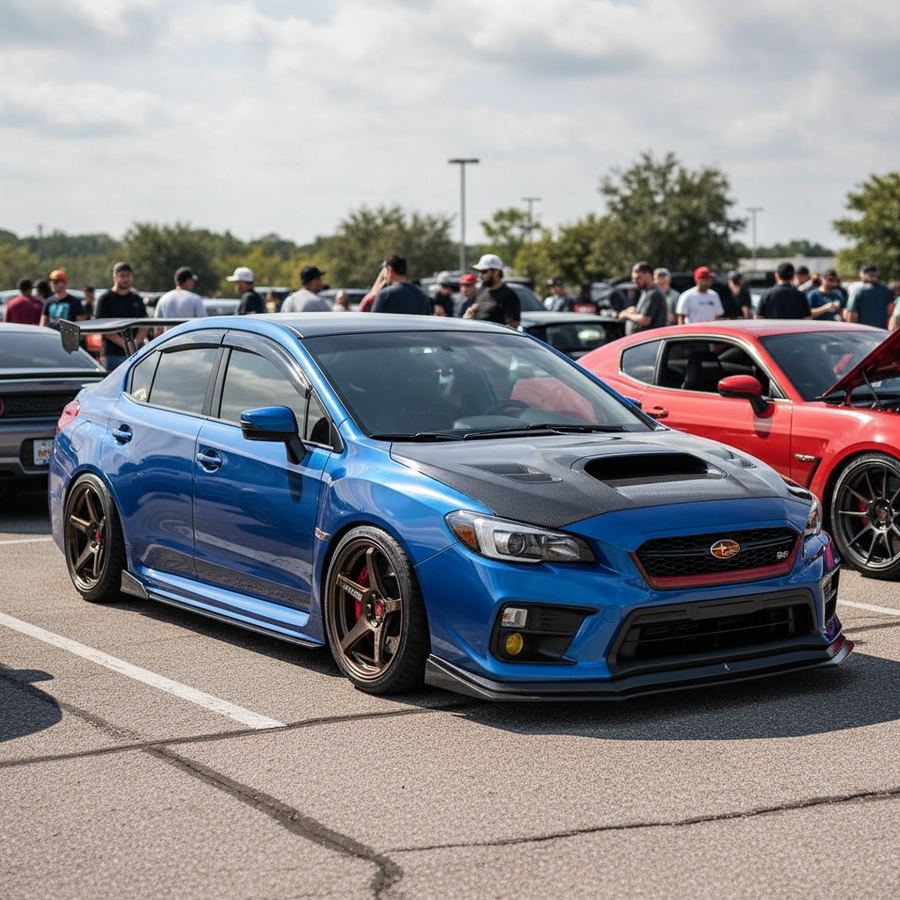
Sofia Chen drives a 2017 Subaru WRX to work every day. She commutes 25 minutes each way on surface streets and I-10 through Tucson, sits in traffic, parks in a garage, and does it all over again the next morning. Nothing remarkable about that, except her WRX makes 400 horsepower at the wheels, runs a Garrett turbo the size of a cantaloupe, and spent last Saturday sideways through a cone course at a local autocross event.
"People ask me why I do not have a separate daily driver," Sofia says. "Because this is a daily driver. It starts every morning, the AC works, it gets 24 miles per gallon on the highway, and it has a back seat. It just also happens to be fast."
The Build Path
Sofia bought the WRX new in 2017 as her first new car out of college. It was stock for the first two years. She drove it to her engineering job at Raytheon, put 30,000 miles on it, and enjoyed it for what it was: a fun, affordable sport sedan with all-wheel drive.
The modifications started small. An Accessport tune, a downpipe, and an intake brought the car from the stock 268 horsepower to around 300 at the wheels. That stage lasted about a year, during which Sofia started showing up to Tucson car meets and learning about the local Subaru community.
"The Subaru scene in Tucson is small but dedicated," she says. "There are maybe 30 or 40 people who show up to the regular meets with WRXs and STIs. Once you are in that circle, the knowledge sharing is constant. Someone always knows a tuner, a shop, or a source for parts. That community is what pushed me to build the car further."
The next stage was a full turbo upgrade. Sofia went with a Garrett G25-660 turbo, a Grimmspeed top-mount intercooler, a Fuel Injector Clinic 1050cc injector set, and a Radium fuel system. Supporting modifications included a Killer B oil pan and pickup, an IAG air-oil separator, and Manley forged internals to handle the added boost. The engine was built by a Subaru specialist in the Phoenix area, and the tuning was done on an EcuTek platform by a remote tuner Sofia had been referred to through the local community.
"The internals were the big decision," Sofia says. "The stock FA20 can handle around 350 wheel horsepower on a conservative tune. Going past that means forged pistons and rods, which means pulling the engine. Once you are that deep, you are committed. I decided to build the engine for 450 and tune it to 400 for reliability. That gives me headroom."
Living With 400 Wheel Horsepower
The car makes 403 horsepower and 380 pound-feet of torque at the wheels on 93 octane, verified on a Mustang dyno. On the street, it drives like a slightly aggressive stock WRX until about 3,500 RPM, at which point the Garrett comes alive and the car pulls hard to redline. The powerband is broad and usable, not peaky and violent like some big-turbo setups.
"The tuner did a great job with the street tune," Sofia says. "Low boost is smooth, the transition is clean, and it does not buck or surge in traffic. If you drove it and did not get on the throttle, you might not know it was built. The idle is stock, the check engine light is off, and nothing rattles."
The transmission is the stock six-speed manual with an ACT clutch rated for 500 pound-feet. Sofia says the clutch is heavier than stock but not miserable in traffic. She shifts around 2,500 RPM during her commute and rarely touches boost unless she is merging onto the highway or passing on a two-lane road.
Reliability has been solid. Sofia has put 18,000 miles on the car since the build, with no major issues. She changes the oil every 3,000 miles with Motul 5W-30, checks the boost logs weekly through the Accessport, and does a full fluid service every six months. The car sees the Subaru dealer for annual inspections, and the technicians there know exactly what it is. They have stopped asking questions.
Autocross
Sofia got into autocross through a coworker who ran a Miata in SCCA events. She showed up to her first event at a parking lot on the south side of Tucson, ran the WRX on street tires, and was immediately hooked.
"Autocross is the best value in motorsport," she says. "For $50, you get a full day of seat time on a closed course with safety workers and timing equipment. You learn car control in a way that street driving never teaches you. And it is addictive. I signed up for the full season after my first event."
The WRX runs in a modified class due to the turbo and engine work. Sofia swaps to a set of 265/35R18 Falken RT660 tires on lightweight Enkei wheels for autocross days. The car also has a set of Bilstein B8 struts with RCE Tarmac 2 springs, which serve double duty as daily suspension and autocross setup. It is a compromise, she admits, but it works for a car that has to be comfortable on Monday morning.
"I am not going to win a national championship with this setup," Sofia says. "The car is too heavy and too powerful for tight autocross courses. But that is not the point. I am out there to improve my driving, have fun, and push the car in a controlled environment. My times have dropped consistently over the past year, and that progression is what keeps me coming back."
She also runs a dashcam during events and reviews her laps afterward, comparing lines and braking points between runs. The analytical approach suits her engineering background and has made her noticeably faster than when she started.
The Meet Scene
Sofia is a regular at Tucson car meets and occasionally makes the drive up to Phoenix for larger events. The WRX fits into both the import meet scene and the broader car culture. She parks next to STIs and Evos at Subaru-specific gatherings and next to muscle cars and trucks at mixed meets without feeling out of place.
"The Arizona car scene is less tribal than people think," she says. "At the big meets, nobody cares if you drive a Subaru or a Camaro. They care if your car is built well and if you have a story behind it. The WRX gets respect at mixed shows because people see a daily driver that makes real power and actually gets used hard. That resonates with anyone who works on cars."
The car sits on its Enkei wheels with a moderate drop that does not scrape on Tucson's rough roads. The exterior modifications are limited to a Seibon carbon fiber hood (for heat extraction, not just looks), a subtle lip kit, and tinted windows. There is no giant wing, no sticker-bombed fenders, and no neon underglow. It looks like a clean, slightly modified WRX. You have to know what you are looking at to understand what is underneath.
"I wanted the car to be fast, not to look fast," Sofia says. "The sleeper thing is not intentional, but I like that it does not draw police attention on my commute. It is World Rally Blue, which is about as Subaru as it gets, but from the outside it could be stock. The surprise factor when I get on it is part of the fun."
Cost and Perspective
Sofia estimates she has about $18,000 in modifications on top of the car's purchase price. The engine build and turbo setup accounted for roughly $12,000 of that. Suspension, wheels, tires, clutch, and miscellaneous parts make up the rest. She did some of the bolt-on work herself in her apartment complex parking lot, which she acknowledges is not ideal but was workable for the simpler jobs.
"It is not cheap," she says. "But compared to buying a car with this kind of performance from the factory, it is a bargain. A new Porsche 911 makes similar power and costs four times what I have into this car total. And I cannot work on a Porsche in my parking lot."
The WRX has become Sofia's entry point into the broader Arizona car community. Through the car, she has met people she now considers close friends, picked up mechanical skills she uses outside of the hobby, and found a competitive outlet in autocross that balances the desk-job routine. She plans to keep the car indefinitely and continue developing it for both street and track use.
"This car is going to hit 200,000 miles," Sofia says. "It might need another engine by then, but the platform is solid and I know it inside and out. Every bolt, every sensor, every fluid passage. That is what happens when you build something yourself. You know it in a way that you never know a car you just bought off a lot."
Sofia brings the WRX to meets around Tucson and the Phoenix area regularly. Check the event calendar to find upcoming shows, or browse more builds in our reader rides section.